
LEADING THE
Recovering, recycling and re-purposing waste into new products, significantly mitigating the environmental strain associated with raw material production while avoiding useful waste sitting in landfills and polluting our environment.
The Climate One team have been involved in out of home printing for over 20 years. 5 years ago, we embarked on a mission to help find a sustainable solution for the PVC print industry.
Utilising world first technology, the mechanical separation recycling process will be able to recycle every billboard that is printed on PVC banner annually and save them from going into landfill. The first Climate One recycling facility is based in QLD with further sites outlined to be built in other states from 2025.
Removal
Installers remove existing billboards from billboard locations across Australia. Climate One arrives and collects the end of life billboards.

Transportation
Climate One Crates are placed in locations around the country. Once full, Climate One will transport to our facility.

Recycling Process
All the collected material is mechanically separated and recycled at our factory.

Output
Recycling into 2nd life PVC products for long term use, extending the lifecycle.


In Australia, the soft PVC industry disposes 22,000 tonnes of waste into landfills annually, with the advertising & media segment of Australia contributing 1500 tonnes of this. When you recycle your out of home campaign with Climate One, your campaign instantly becomes not only Nature Positive,
but you are given the data from a globally accredited company to show what your campaign has contributed to in its second stage of life. The data can also be used for your own ESG commitments.
Who is Climate One?
Our History
Climate One wasn’t built overnight. Our business has over 20 years of experience in out of home print and the outdoor advertising market. For 5 years we have been trialling different models of recycling, working with various stakeholders and investigating the best sustainable solutions to ensure the static out of home industry continues to thrive using the best products available to market.
Industry Problem
In Australia, the soft PVC industry disposes 22,000 tonnes of waste into landfills annually, with the advertising and media segment of Australia contributing 1,500+ tonnes of this, with an estimated 115,000 tonnes of soft PVC in circulation. Plastics constitute a minor fraction of Australia’s overall waste, accounting for approximately 3%. However, in the fiscal year 2020-21, merely 13% of plastics are recycled, whilst the rest find their way to landfills.
It’s important to note that this statistic is based on the weight of plastics, which, being lightweight compared to other materials, may not accurately capture the actual volume of plastics consumed in Australia. These figures don’t account for the broader environmental consequences of plastic usage, including pollution, litter, greenhouse gas emissions, and water consumption.
The Solution
Climate One has found the solution for soft PVC plastic waste in Australia. With a strong belief and a clear vision, we have been developing a PVC recycling solution over the last 5 years. Our initial plant in Queensland will have the capacity to recycle 4,000 tonnes of soft PVC annually. Within 18 months of operation, we plan to introduce more recycling facilities in other states. Climate One is working on further solutions for a more diverse range of products in the near future.
Recycling Road Map
Climate One plans to introduce more complex plastic separation. This will increase the products that we can recycle and expand the number of products that can be repurposed.
Phase One
Phase One will involve a mechanical separation allowing for PVC and polyester products to be micronised into dust, whilst separating the PVC and polyester fibres. These fibres are then repurposed into new PVC or Polyester products.
Output: Vinyl carpet tiles, Advertising banner & automotive panels.
Phase Two
Phase Two will allow us to take additional PVC product types and separate more complex plastic combinations. This will also allow for additional methods of output through separation of plasticisers to recreate rigid PVC granules.
Output: Open to almost any PVC extruded currently in the world.

Recycling Process
Climate One will collect all allocated material from installers in Climate One Crates. These will be available at installer sites to easily fill with end-of-life billboards.
The collected billboards are sorted, cleaned and any contaminant products are removed (Eyelets, ropes & any other non-PVC/Polyester products).
Our process takes the billboards and breaks them down to a molecular level, separating the PVC and Polyester fibres. This is done through a mechanical process (World first technology) with no chemicals involved.
The PVC and polyester fibres can then be repurposed into any number of new PVC and polyester products. This will avoid the need to collect new natural minerals and reduce the carbon impacts of refinement and polymerization into PVC and Polyester materials.
Why PVC?

PVC is the most sustainably manufactured, trusted and widely used banner fabric in the market to date. This product is approved to be used on all out of home media companies’ sites and is manufactured in frontlit, backlit and lightweight options. It can also be printed in one piece up to 5m wide. Now with an end of life recycling solution, PVC banner fabrics are the most widely usable and sustainable product in market.
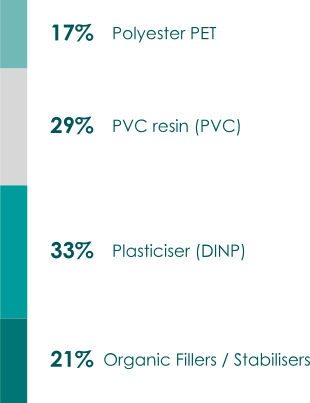
PVC has a lower carbon footprint than alternative non-PVC products including polyolefin’s, Polypropylenes and polyethylene’s. Furthermore PVC banner contains 17% polyester (PET), 29% PVC resin (PVC), plasticiser (DINP 33%) and the remaining 21% is made up of organic fillers and stabilisers CaCo3 – 13% (Limestone/Marble/Eggshells/Chalk/Sea Shells) Titanium oxide 3%.
For more information on PVC sustainability please see the European Council of Vinyl Manufacturers (ECVM).
IT’S TIME TO END GREENWASHING.
Global Green Tag
Greenwashing has ruled in the eco market. Any brand can claim to be an environmental saviour with a few ‘natural’ ingredients and some sharp marketing. Buyers don’t know who to trust. Fake products in green packaging take sales away from genuinely deserving brands. The planet continues to be exploited in the name of inauthentic green design. Everyone suffers.
Climate One has entered into an agreement with Global GreenTag for our initial Environmental Product Declaration (EPD), Global GreenTag will continue to audit our process and improve the EPD reporting as the program scales and develops.
Our Accredited Partner
Climate One has partnered with Global GreenTag, with the goal to achieve Nature Positive accreditation. With assessment underway we hope to announce our accreditation shortly.
The Global GreenTag International NaturePositive+ Declaration™ catapults product certification beyond current thinking on circular economy and carbon; holistically measuring products for benefits as well as impacts using metrics across circularity, climate repair, life cycle analysis, ingredient hazard, supply chain transparency, social and indigenous benefit, safe and ethical supply chains, modern slavery risk assessment and innovation to ensure net NaturePositive product outcomes that can be trusted. As part of the NP+D process, an Environmental Product Declaration for the final recycled raw materials will be produced.
For more information visit:
globalgreentag.com/npd-program
Stage 2 of our EPD will capture the life cycle of the newly created products from the Climate One recycling program, further understanding the impact of the complete life cycle of PVC, Polyester and supply chain logistics of the products used and the products created.
This will allow us to not only report on the two end of life pathways but further the reduction in raw material manufacture and transport of materials into Australia from around the world.
LEARN MORE: Watch our explainer video
We’re here to help.